.svg)

Conventional security fencing is often costly, not very visually appealing, and perhaps most importantly ecologically sterile. A compelling alternative is the use of “living fences”: plantings of thorny shrubs, trees, and succulents that provide effective security while simultaneously enhancing biodiversity, improving aesthetics, and even producing food. In the past, species such as prickly pear (Opuntia) and Agave were often used as living fences or hedges, but many are now recognised as invasive in South Africa. Fortunately, a wide variety of southern African indigenous species can be used here in the Western Cape to build effective living fences. Unlike conventional fencing, living fences actively contribute to ecosystem processes. Flowering species support pollinators, fruiting species provide food for birds and mammals, and dense vegetation offers shelter and nesting sites. In urban environments, these hedges can even function as corridors for wildlife. In this article, we highlight a range of indigenous species suited to living fences—starting with commonly available nursery species and then moving on to less familiar, but highly effective options.
Our Go-To Species For Living Fences
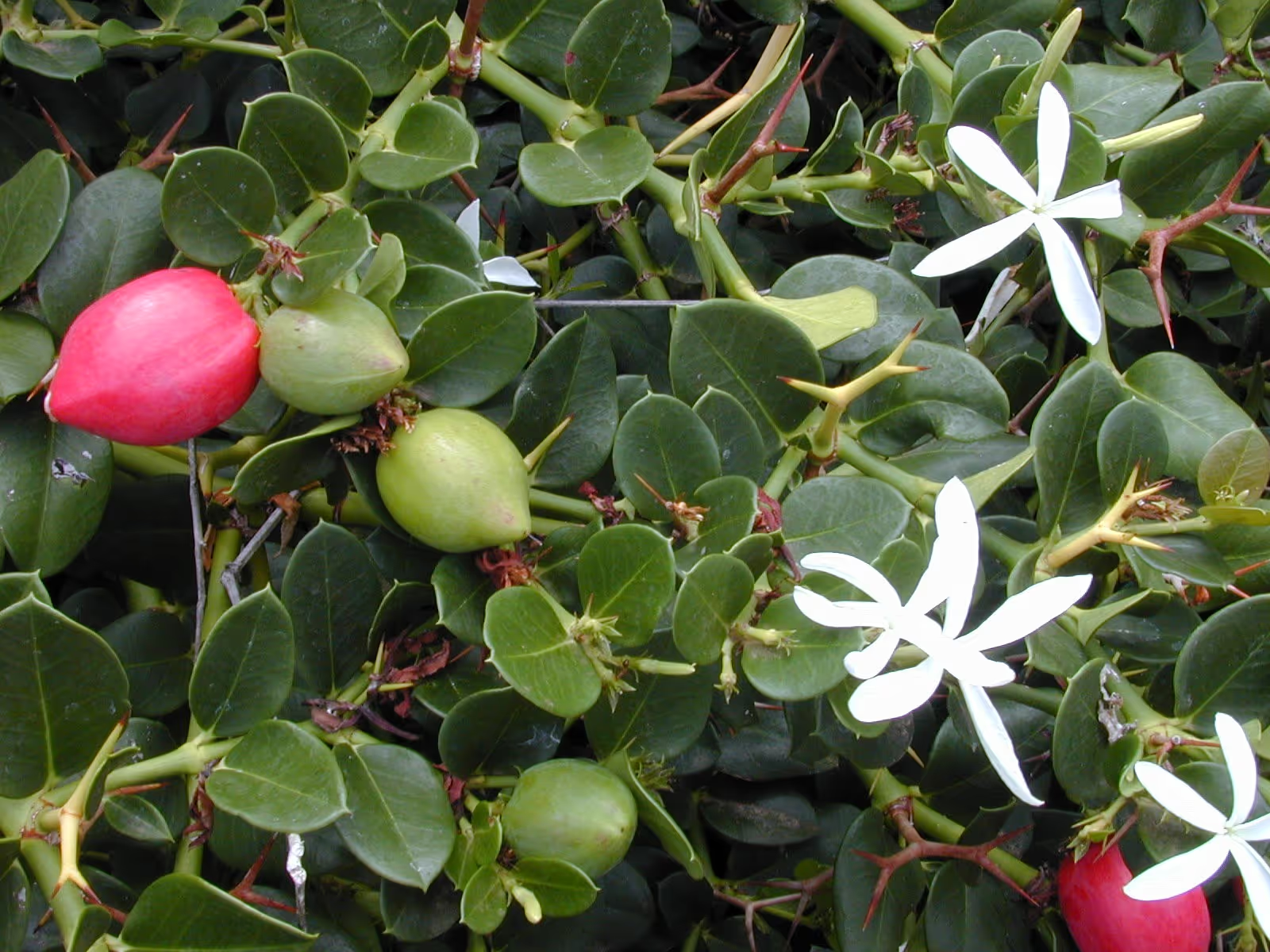
Only two indigenous species are commonly available in nurseries and garden centres, and these, for good reasons, tend to be the preferred choices for living fences. Natal plum or Big num-num (Carissa macrocarpa) is one of the most reliable hedge plants in the region. It’s an evergreen shrub or small tree (about 2–8 m tall) that naturally occurs along coastal dunes and forest margins from the Eastern Cape northwards through KwaZulu-Natal to Mozambique. The rigid Y-shaped spines make it an excellent barrier, while the white flowers and large red fruits are regularly visited by insects and birds. Although it doesn’t occur naturally here, it is very well adapted to the conditions in the Western Cape, but takes a few years to be big enough to form a fence. A close relative, the local Forest num-num (Carissa bispinosa), is a smaller and slower-growing shrub (1–5 m) that tends to prefer semi-shaded conditions. Kei-apple (Dovyalis afra) is another important species for security hedging. It’s an evergreen shrub or small tree (3–8 m) that occurs naturally from the Eastern Cape through KwaZulu-Natal and into parts of the northern provinces and Zimbabwe. The long spines (40–70 mm) make it extremely effective as a barrier, and it handles both full sun and partial shade without much fuss. It is fast-growing and also responds very well to pruning, which is why it’s so widely used in traditional living fences. And as a bonus, the fruit is edible and often turned into jams and preserves.
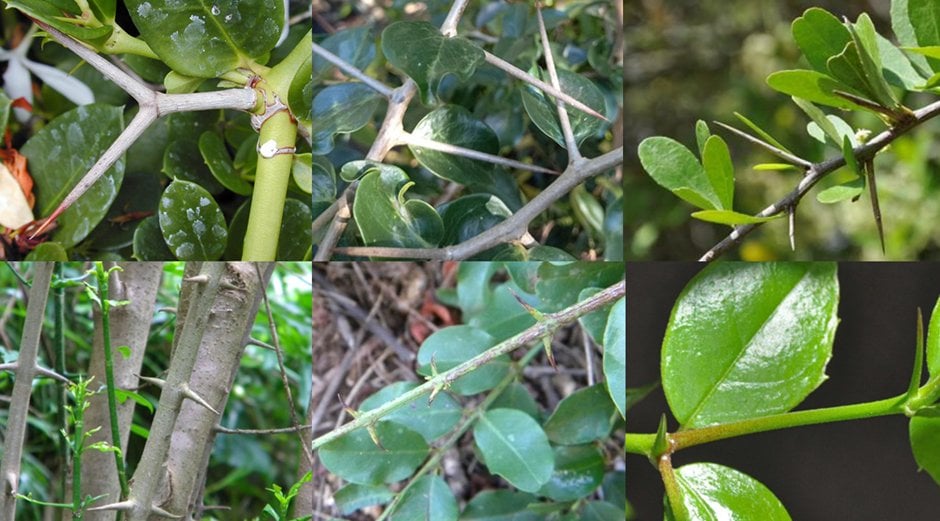
Spines of six indigenous plant species that can be used for living fences. From top to bottom, left to right: Big num-num (Carissa macrocarpa), Kei-apple (Dovyalis afra), Spikethorn (Gymnosporia buxifolia), Turkey-berry (Canthium inerme), Cat-thorn (Scutia myrtina), and Lemon thorn (Cassinopsis ilicifolia).
The Less Familiar Options
Beyond Natal plums and Kei-apples, several other indigenous plants can be used to build excellent security fences, but they are not always easy to find in regular nurseries. In many cases, you may need to track down a specialist indigenous plant nursery, or be prepared to grow them from seed and invest a bit of patience while they establish. Spikethorn (Gymnosporia buxifolia) is a highly valuable but often underutilised species for living fences. The plant typically grows as a large shrub around 3 m tall and is widely distributed across southern Africa, including the Western Cape. It is armed with sharp, slender to more robust spines ranging from about 3.5 to 100 mm in length, and can be trimmed to create a dense, impenetrable hedge. Spikethorn is drought-resistant and a tough pioneer species, well-adapted to harsh environments. Turkey-berry or ‘bokdrol’ (Canthium inerme) is a relatively common species with a wide distribution across southern Africa. It shows considerable variation in growth form depending on its habitat, ranging from a small shrub to a tree up to 14 m tall. Branches, particularly sucker shoots, may be armed with strong, stout spines up to 70–80 mm long, although these are generally less formidable than those of many other hedge species discussed here. While not as strongly armed, Turkey-berry responds well to pruning and can be shaped into a formal hedge, making it particularly useful for filling gaps and increasing the overall density of the living fence. Its fruits are eaten by birds, other animals, and even people. Two closely related species, the Armed or False turkey-berry (Canthium armatum) and Thorny turkey-berry (Canthium spinosum), which occur mainly in the eastern parts of South Africa, also form excellent hedge plants. Their conspicuous spines increase their defensive value, and regular trimming promotes dense, spiny regrowth that persists for many years. Cat-thorn (Scutia myrtina) is a scrambling shrub or climber that can reach up to about 9 m in height. It occurs mainly in the southern Cape and eastern provinces, typically along forest margins and in wooded habitats. It tolerates a wide range of light conditions, from full sun to shade. The branches are armed with sharp, curved thorns, allowing it to form a dense, interwoven, and effectively impenetrable hedge when established.
Lemon thorn (Cassinopsis ilicifolia) is an evergreen, scrambling shrub that typically grows up to about 4 m high and wide. It has a wide distribution range in South Africa and occurs naturally in montane forests and forest margins. The branches are slender and trailing, often growing in a characteristic zigzag pattern, with sharp, narrow green spines along the stems that contribute to its defensive structure. The fruits are eaten by a wide range of bird species, and while edible for people, they are not particularly palatable. Coast Kei-apple (Dovyalis longispina) and Common sourberry (Dovyalis rhamnoides) are closely related to the more familiar Kei-apple. The Coast Kei-apple occurs in coastal bush on sand dunes in KwaZulu-Natal and is typically a tree (5–10 m) with very long, slender, straight spines up to 80 mm. Despite its size, it responds well to heavy pruning and can be trained into a functional barrier plant. The Common sourberry is a smaller shrub (1–6 m) that occurs widely in KwaZulu-Natal and grows in bushveld and forest margins. Both species produce edible fruit. With the right species and a bit of patience, living fences offer a practical way to secure properties while actively supporting biodiversity, and they also encourage greater use and cultivation of indigenous plants.
Written by Chris Broeckhoven (SBC Vice-chair)