.svg)

.avif)
There is much talk about invasive alien vegetation and how it is driving the increase in veld fires, stealing our water, and smothering our endemic vegetation. But what does this mean, why should you care, and what can we do about it?
Who are they?
Black wattle, Port Jackson, Eucalyptus, Pine, and Hakea are some of the thirstiest invaders in South Africa, with their invasive stronghold in the Western Cape. All, except the Pine, were introduced from Australia in the 1800’s for a variety of reasons.
Black wattle was initially introduced for its high-quality tannin needed in the leather tanning industry. In later years, it was planted for shade, firewood, and served as a cheap source of timber.
Port Jackson was brought into South Africa primarily to stabilize the shifting coastal sand dunes and roadsides, later it was also used for fodder, firewood, and tanning.
Eucalyptus, on the other hand, was seen as the answer to South Africa’s critical, local shortages of timber and firewood, as native trees grew too slowly to meet the railway fuel and construction material demand.
Likewise, Pine was introduced from Europe to provide South Africa with a reliable, fast-growing source of timber as local indigenous trees were either not suitable or slow-growing (e.g., yellow wood). The early settlers also liked to plant pines as it made the landscape look ‘tamer’ and familiar, and it makes for a very good windbreak.
Hakea (primarily Hakea sericea) was introduced to South Africa to serve as a hardy hedge plant, suitable for demarcating property boundaries and providing shelter.
Smothering our endemic vegetation
All of these invasive trees share the same traits driving their invasive success in South Africa (and beyond) and were ironically the reason for their introduction in the first place. They are (1) fast-growing trees that (2) thrive in a variety of soil types, (3) don’t mind nutrient-poor environments, and (4) have aggressive root systems.
In addition, these invasives also have a few more tricks up their proverbial sleeve to help them outcompete local vegetation. For example, blue gum (Eucalyptus globulus) trees are often said to “poison” the soil. Though not an entirely accurate accusation, blue gums do alter the soil chemistry as they release allelopathic compounds that can inhibit the germination of other plants. Likewise, black wattle also changes the soil chemistry to promote its own growth. In addition to also producing allelopathic compounds, thick stands of wattle increase soil carbon, which in turn alters the soil microbiome.
Moreover, as a legume, the wattle fixes nitrogen, thereby increasing soil nitrogen levels. Thick wattle stands also decrease the soil pH, making it more acidic, a change that can persist even after clearing the trees.
Stealing our water
Invasive alien plants don’t just use the groundwater, but they alter the hydrological cycle in its entirety, impacting both surface and groundwater in several ways. According to the Water Research Commission, more than 7% of all water runoff in South Africa is lost to alien plants. Most invasive trees also have deeper, more aggressive root systems and higher evaporation rates when compared to native fynbos or grassland, thereby reducing streamflow and drying up catchment areas.
Promoting veld fires
All plants, native or invasive, burn in a fire, but invasives burn at much higher temperatures than the native (fynbos or grassland) vegetation. Invasive trees like wattle and blue gum also increase the biomass and fuel load by up to 300%. These high-heat bonfires damage the soil structure and kill the native, fire- adapted vegetation, while promoting the recovery of the invasive plants themselves.
Masbiekers Valley
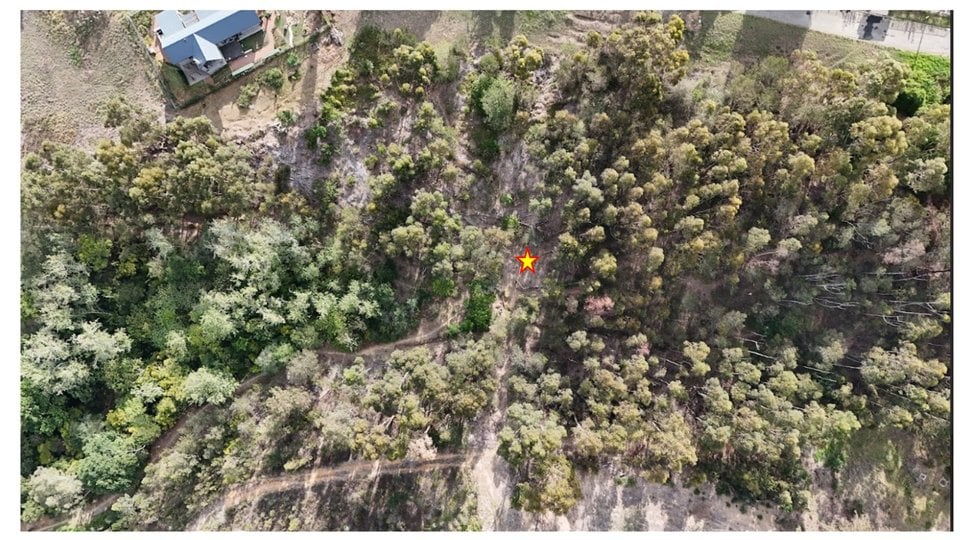
The Masbiekers Valley is situated in the heart of Swellendam and is overrun by invasives, with blue gum and black wattle being the most prevalent.
With the SBC’s Masbiekers Adopt-A-Spot (effective from 1 January 2026), we aim to reduce Swellendam’s immediate fire risk by working alongside the Alien Invasive Hackers in removing the alien vegetation. We will create a fire break at the Buitekant Street entrance and plant fire-retardant indigenous plants within it.
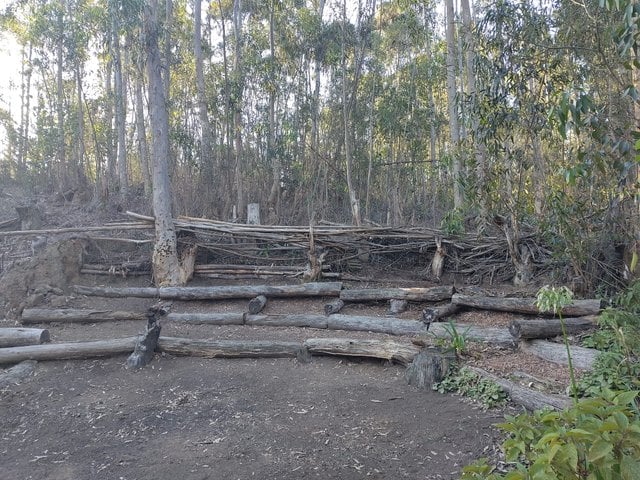
In addition, we aim to stabilise degraded areas, decrease the fuel loads, and increase the soil quality with methods like Hugelkultur.
All areas cleared of alien invasive vegetation will be restored by planting (locally) indigenous trees and shrubs, promoting biodiversity and a healthy, clean area for all Swellendammers to enjoy!
Article by: Genevieve Diedericks
Photos by: Genevieve Diedericks
Hero photo: Acacia saligna — Alvesgaspar (CC BY-SA 4.0), via Wikimedia Commons.