.svg)

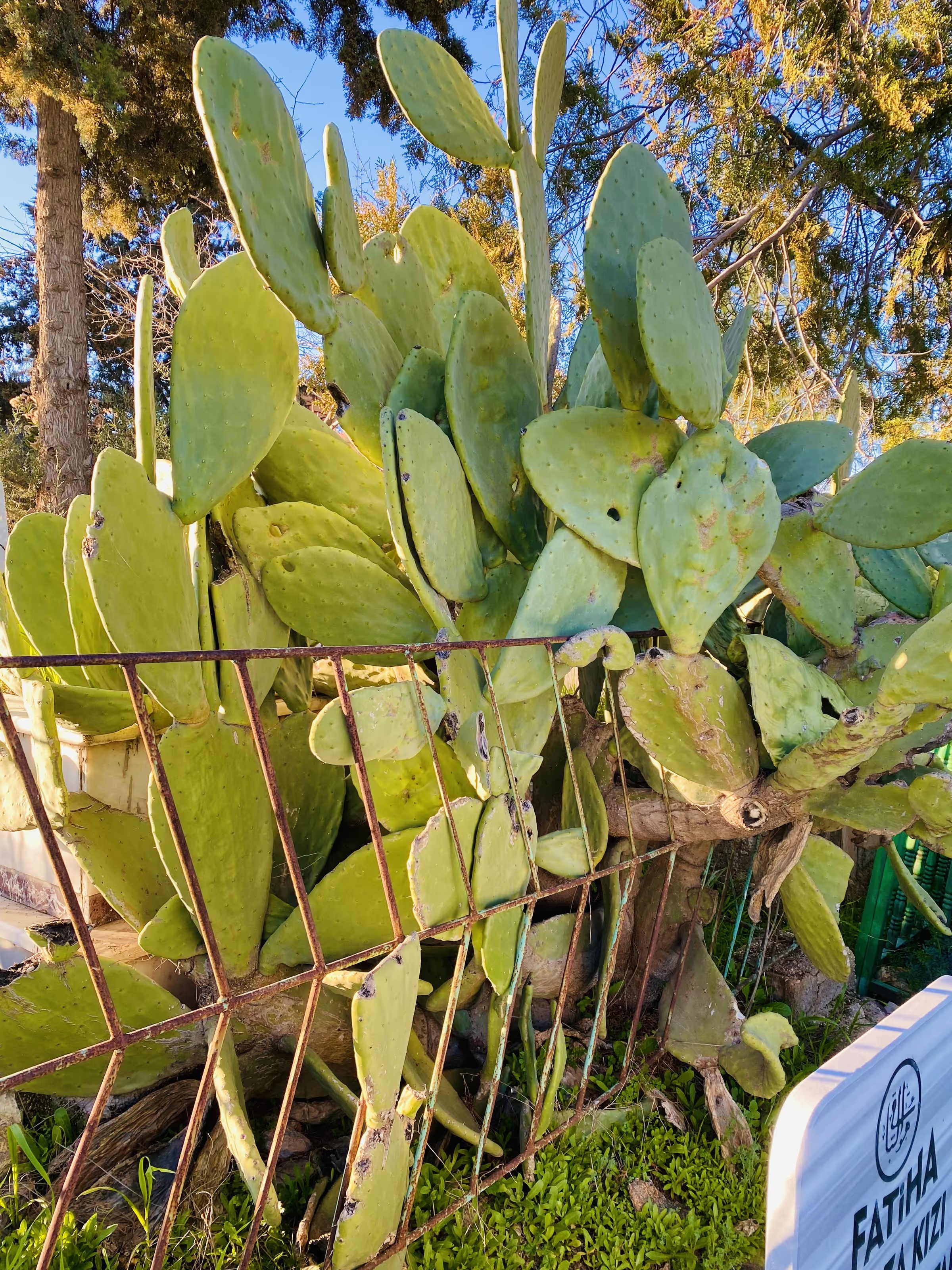
There are hundreds of cactus species native to the Americas, growing in an incredible variety of environments, from hot deserts and sandy coastlines to mountain regions and even tropical forests. This adaptability allows many species to thrive far beyond their natural distribution, including in places like South Africa. Yet, interestingly, only a small fraction, about 3% of all cactus species, have become invasive outside their native range.
That might sound insignificant, but these few species can have a big impact; they can spread rapidly and cause serious problems, especially in dry areas.
This raises an important question: why do only some cacti become invasive, while most do not? Understanding this is key to managing existing invasions and preventing new ones in the future.
Why are some cacti invasive?
Research shows that invasiveness in cacti is not random; some groups are simply more likely to spread than others. In South Africa, most invasive species belong to the so-called “opuntoid” cacti, a group that includes familiar plants like prickly pears (Opuntia), chollas (Cylindropuntia), and their relatives.
By contrast, many other cacti, despite being widely cultivated, have never become invasive. This tells us that invasiveness is not simply driven by human use or introduction.
Many cactus species have been moved around the world, yet only a handful have become problematic.
The difference lies in how they grow and reproduce.
Some cacti have a combination of useful but risky traits: they can grow from broken pieces, survive tough conditions, and spread easily through animals, water, or human activity.
These features give them a clear advantage once they escape into the wild (Figure 1).
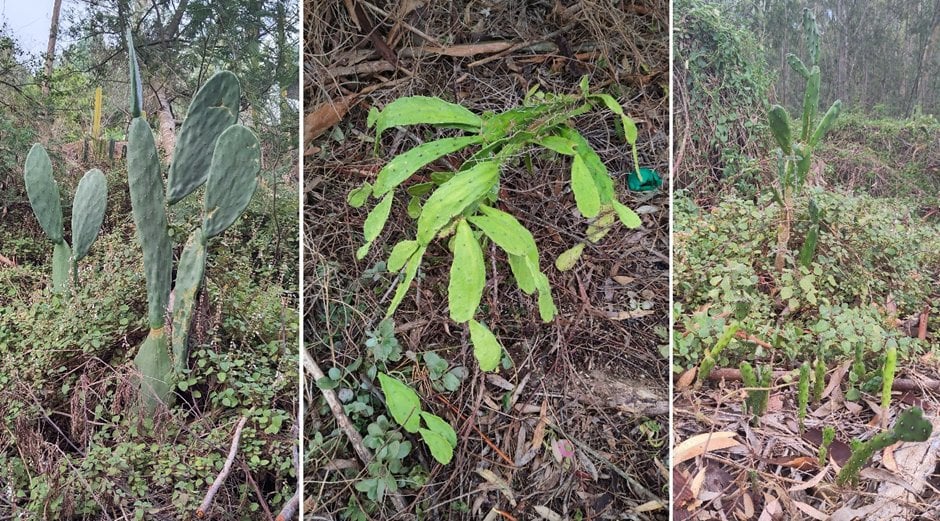
A variety of opuntoid cacti are spreading in Masbieker’s Kloof after being dumped or discarded as garden waste. Broken segments root easily, turning a single plant into a growing infestation.
Growth Form Matters
A key factor underlying these differences is growth form, i.e., the shape and structure of the plant. Cacti occur in a wide range of growth forms, from compact globose types to tall columnar and tree-like species. In total, twelve distinct growth forms are recognised (Figure 2), but only a few are linked to invasiveness.
In South Africa, all invasive cacti fall into just five growth forms: cylindrical, flattened-padded, sprawling, leaf-like, and angled. Among these, the flattened-padded forms (like Opuntia) are especially common among invasive species. On the other hand, some forms are completely absent from invasion records, most notably the round, globose types, which have never been recorded as invasive, but are commonly available in nurseries. The reason comes down to how these plants grow.
Many invasive cacti, especially the flattened-padded types, can reproduce extremely easily from pieces. Even a single broken segment can fall to the ground, take root, and grow into a new plant. These segments are easily carried around by larger animals or spread through routine activities like clearing land (Figures 1, 2).
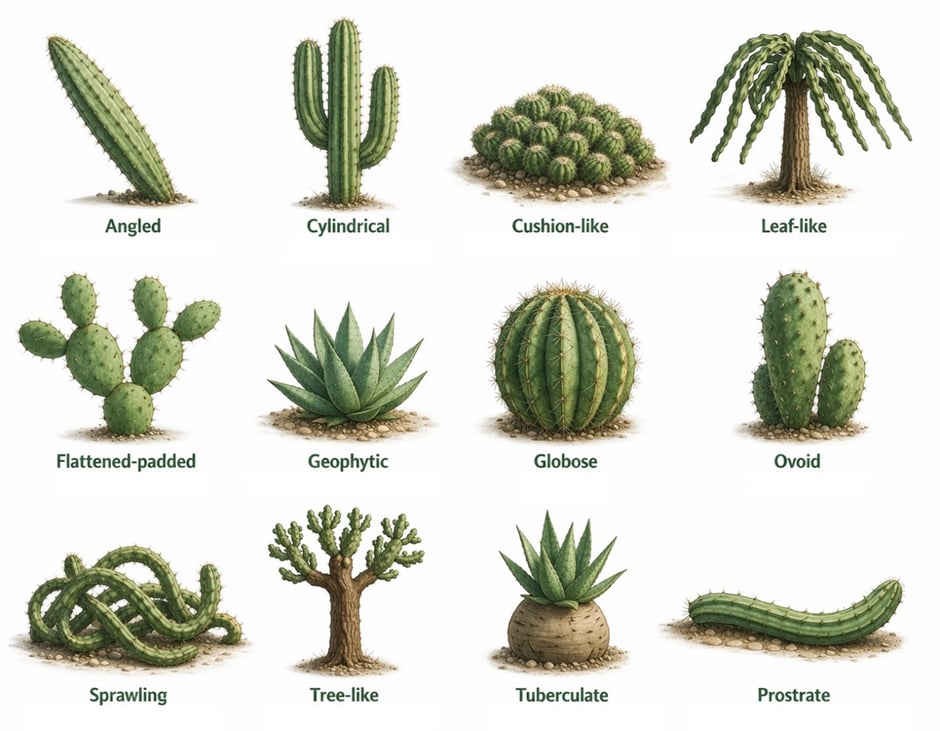
Twelve distinct growth forms of cacti, of which angled, cylindrical, leaf-like, flattened-padded and sprawling have the highest invasive potential. Digitally redrawn and adapted from Novoa et al. (2014).
For this reason, if you remove these plants, never leave the pieces on the soil; place them on rocks or hard surfaces to dry out completely, or ensure they are thoroughly destroyed (e.g., finely shredded so no intact pieces remain), as larger fragments can readily re-root. Spreading and angled forms behave in a similar way, often breaking apart and quickly colonising nearby areas, especially where the land has been disturbed. In contrast, round and single-stemmed cacti rely almost entirely on seeds, grow more slowly, and cannot regrow from broken pieces. This makes them far less likely to spread aggressively. Understanding this gives us a practical advantage: by recognising high-risk growth forms, we can avoid planting species that are more likely to become invasive in the first place.
Useful Plants, But Not Without Risk
Cacti are not just ornamental; they can also be valuable food crops.
Two well-known examples are: Prickly pear (Opuntia ficus-indica, or turksvy) and Dragon fruit (Selenicereus species, previously known as Hylocereus). In South Africa, the use of these plants is regulated under the National Environmental Management: Biodiversity Act (NEMBA), the country’s main law for managing biodiversity and invasive species.
Prickly pear is widely used for fruit and as livestock fodder, but it is listed as a Category 1b invasive species. This means it may not generally be grown, propagated, or traded. However, there are important exceptions: spineless cultivars are not listed, and the fruit can be sold freely for human consumption.
Dragon fruit is treated differently. The commonly grown white-fleshed species (Selenicereus undatus) is listed as a Category 2 species, meaning it may only be grown with a permit, while the fruit can be traded without restriction. Interestingly, the red-fleshed varieties (such as Selenicereus costaricensis) are not currently listed, likely because they are relatively new in cultivation and have not yet shown the same invasive behaviour.
A Better Way Forward For Gardens And Landscapes
In water-wise areas like Swellendam, succulents are an excellent choice, but choosing the right species is key. Instead of planting potentially invasive cacti, we can make use of South Africa’s rich diversity of indigenous succulents, particularly Euphorbia species. These plants come in a wide variety of forms, from compact, rounded forms to upright, ribbed stems and even tree-like structures.
Many euphorbias closely resemble cacti in both appearance and function (Figure 3), offering the same bold, sculptural look in the garden. The difference is that they are naturally part of our ecosystems. By choosing indigenous species, we can create beautiful, drought-tolerant landscapes while supporting local biodiversity and avoiding future invasions.
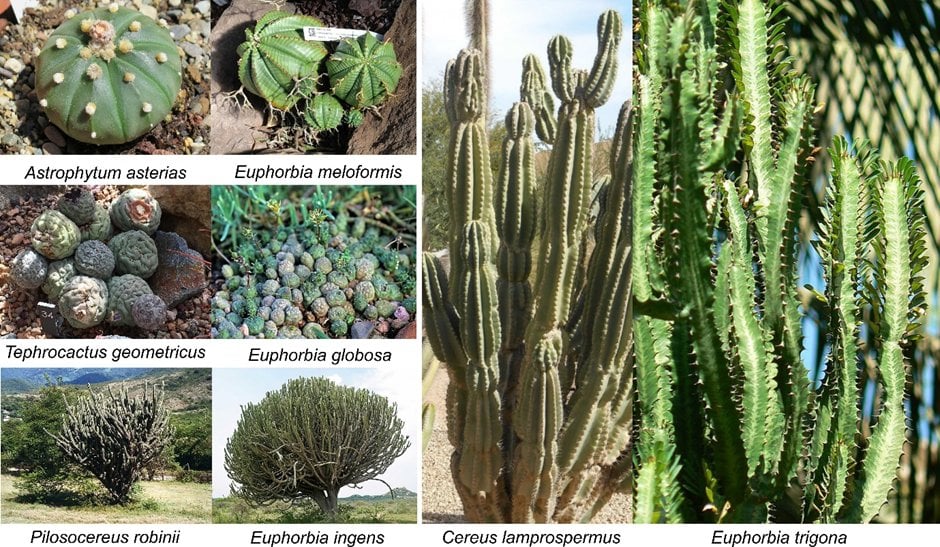
Cacti and euphorbias showing striking similarities in growth forms (globose, cushion-like, tree-like and cylindrical). Images from Wikimedia Commons.
Written by Chris Broeckhoven (SBC Vice-chair)