.svg)

The holidays are upon us, and for many, this means some well-deserved family time and fun activities. Many of us enjoy wildlife, and here in SA we are spoilt for choice with our numerous Nature Reserves and game parks. Unfortunately, however, not all of these places have the animals in their care’s best interests at heart, and by supporting these establishments, you are actually contributing to their suffering, and in some instances, even their death! Of course, if you don’t know, then this is not done on purpose, but ignorance is bliss. So, to help you in making informed decisions about the places you’d like to visit, here are some guidelines as well as recommendations.
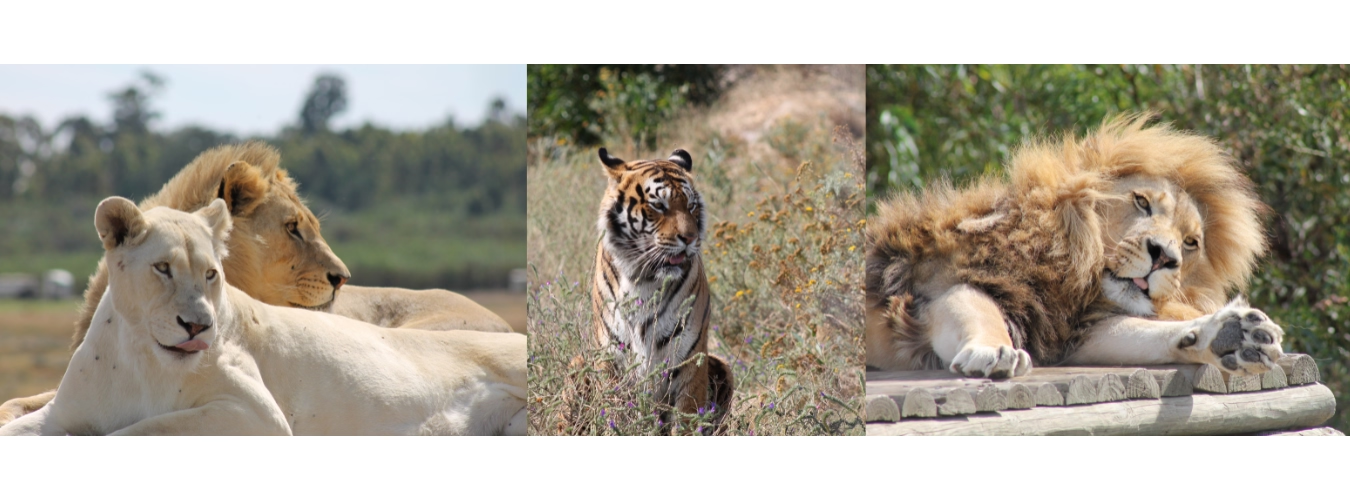
Big Cats: If an establishment housing big cats (lion, leopard, cheetah, tiger, etc.) offers cub petting or bottle feeding, playing or interacting with the animal in any way, it is not a true sanctuary. These cats are often destined to be used in the canned hunting industry or the bone trade industry. A true sanctuary will also not promote breeding their cats in any way. Real sanctuaries worthy of your time (and money) are Drakenstein Lion Park (situated near Paarl), Panthera Africa Big Cat Sanctuary (near Stanford), and Jukani (Plettenberg Bay). The majority of the big cats in their care were rescued from circuses, zoos, and war-torn regions across the world, as well as canned hunting farms. As it is summer, and cats being cats (i.e., sleeping most of the time), it is recommended to visit during feeding times to see the animals up close and at their most active. *Canned hunting: A trophy hunt where the animal is typically kept in a confined area to make it an easy kill. *Bone trade: The commercial sale of lion bones to markets in Southeast Asia where it is used in traditional medicine.
%20(1000%20x%20800%20px)%20(1000%20x%20450%20px)%20(1350%20x%20500%20px).avif)
Birds: Most of us love looking at exotic birds (think Macaw, African Grey, Cockatoos, etc.), but birds need space and highly intelligent birds, such as parrots, require mental and physical stimulation to prevent stress, boredom, and destructive behaviours like feather plucking. A small cage is thus not the right way to house a bird! Moreover, most birds are social and require interaction with their own kind, forming large flocks or colonies. If the establishment you intended to visit has birds in pairs in an enclosure, the chances are good that they are breeding (and selling) the birds and that the birds’ well-being is not the priority. A true paradise for all bird enthusiasts is Birds of Eden (Plettenberg Bay). It is the largest free-flight aviary in the world, and they have more than 3500 birds in their care. A definite must-do if in the area!
Primates and other animals: Zoos are often considered controversial as the animals, often only one or two of a species, are kept in small enclosures and with no stimulation, often on a concrete or non-natural substrate (for cleaning purposes). They claim to have certain animals in their care to aid in the species’ conservation. Unfortunately, however, this is most often not the case. Very few places house and breed their animals for reintroduction into wild spaces, but rather use them as a marketing tool to lure people to visit. Moreover, if you think from a conservation perspective, zoos often only have a pair or two of a species, so inbreeding is a very real concern, and releasing such individuals (if it were ever to happen) would do more harm than good to the wild populations. A viable breeding program would mean getting new genetic material from other places (either artificial insemination with imported sperm or bringing in an animal from somewhere else to mate), a very costly endeavor for a zoo. Two places not too far away from us that have an array of animals in their care are Exotic Pet World (in Klupmuts) and Monkeyland (Plettenberg Bay). Both establishments provide a forever home to their animals, which they have acquired from closed zoos, parks, or even ex-pets. Exotic Pet World is also home to many confiscated animals, often destined for the illegal pet trade. Monkeyland is the world's first free roaming multi-species primate sanctuary and is home to 550 lemurs, apes and monkeys.
%20(1000%20x%20800%20px)%20(1000%20x%20450%20px)%20(1350%20x%20500%20px)%20(1).avif)
Other sanctuaries worthy of a visit:
Greyton Farm Animal Sanctuary (just outside Greyton): The farm is home to around 200 pigs, sheep, goats, cows, geese, chickens, peacocks, a duck as well as elderly and afflicted dogs and cats.
Farm Sanctuary SA (Franschhoek valley): A sanctuary for rescued farmed animals. The sanctuary also offers wine-tastings, unique barn accommodation, a plant-based café - and is also home to the famous painting pig, ‘Pigcasso, and painting sheep, Baanksy.
Eseltjiesrus Donkey Sanctuary (McGregor): Eseltjiesrus provides a permanent home and loving care to destitute, rescued donkeys.
Article and Photos by: Genevieve Diedericks (SBC Vicechair)