How good intentions can harm or kill wildlife.
Humans often do things out of care and compassion rather than malice. As such, we seldom stop to think and question our actions but rather assume that they will be beneficial to the receiving party. In this series we will explore a number of practices many of us partake in and ask: Why do we do what we do, what are the negatives associated with it and what should we do to make our action as beneficial as intended.
Pet hair as bird nesting material.
Spring has sprung. Flowers are blooming, bees are buzzing and birds are starting to build their nests. To provide a soft and warm environment for their eggs and hatchlings, birds line their nests with feathers, fur or hair – most often domesticated pet hair. Because dogs and cats shed their thick winter coats during spring, many of us may also actively be ‘hanging out’ fur for the birds to use, thinking we are aiding them in making their nests more “homely”, but our actions may in fact be deadly.
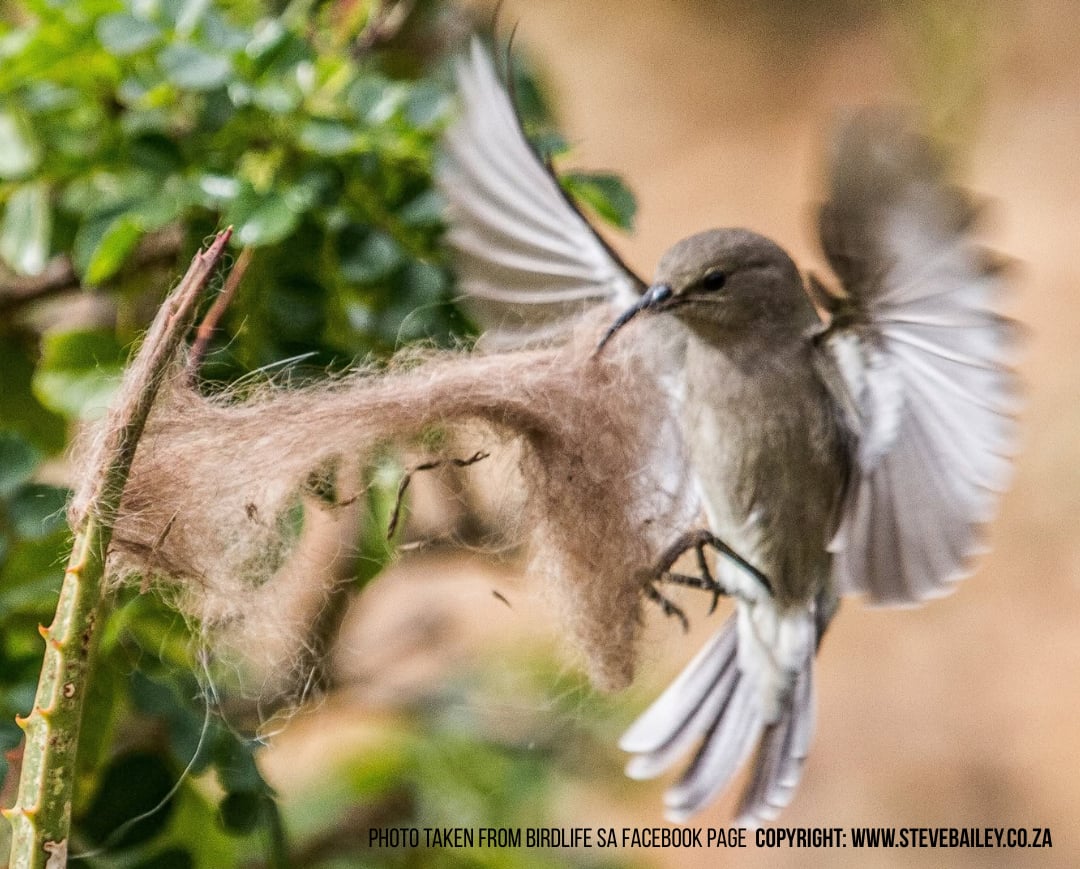
The problem with pet hair isn’t the hair, but rather the poison hidden in the hair follicles. Most companion pets are routinely treated for ectoparasites (ticks & fleas), with chemicals either given orally or applied topically in the form of shampoos, spot-on treatments, sprays, or impregnated collars. The active compounds/ chemicals in these ectoparasitic treatments remain in pet hair even when the hair is shed.
Numerous scientific studies have measured the range and concentration of these chemicals in dog hair, with afoxolaner, fluralaner, fipronil and imidacloprid detected in hair and urine samples (Diepens et al., 2023).
In two independent studies looking at two different bird species, the blue tit (Cyanistes caeruleus) and the great tit (Parus major), chick mortality was directly linked to these insecticides.
The first study, conducted in the Netherlands (Guldemond et al., 2019), identified 26 different insecticides, including imidacloprid (found in Advantage®, Advocate®, and Advantix®) and fipronil (the active compound in Frontline®), in samples collected from deceased great tit chicks.
In the second study, carried out in the United Kingdom (de Montaigu et al., 2025), all 103 nests tested contained fipronil, with the majority also containing imidacloprid and permethrin. These studies concluded that it was the direct contact between the baby-bird skin and the pet hair that served as the exposure pathway for these chemicals, which ultimately caused their death.
Despite these studies not being conducted in South Africa, or on South African birds, many of our local bird species, like the sunbirds, weavers, Cape robin-chat and Fiscal shrike, do line their nests with fur. So, what can we do to keep our pets free from ectoparasites but also help our birds? (1) If you use chemicals on your pet, brush your pet at home and discard of the hair with your household waste rather than letting it ‘fly’ outside. (2) Rather than use flea treatment monthly as a preventative measure, only use it when your pet has them. (3) Look into alternative non-chemical preventative measures.
Guldemond, A., Gommer, R., Leendertse, P. and van Oers, K. 2019. Koolmezensterfte en buxusmotbestrijding: Pesticidenbelasting bij jonge koolmezen. CLM Onderzoek en Advies.
Diepens, N.J., Belgers, D., Buijse, L., and Roessink, I. 2023. Pet dogs transfer veterinary medicines to the environment. Science of The Total Environment. Volume 858, Part 1, 159550.
de Montaigu, C.T., Glauser, G., Guinchard, S., Goulson, D. 2025. High prevalence of veterinary drugs in bird's nests. Science of The Total Environment, Volume 964, 178439.
*This article was written by Dr. Genevieve Diedericks (SBC Chair) and reflects her views and opinions. All sources can be found at the bottom of the article. Google was the search engine used to research this article. No ChatGPT, Gemini or other AI tools were used in producing this article.